
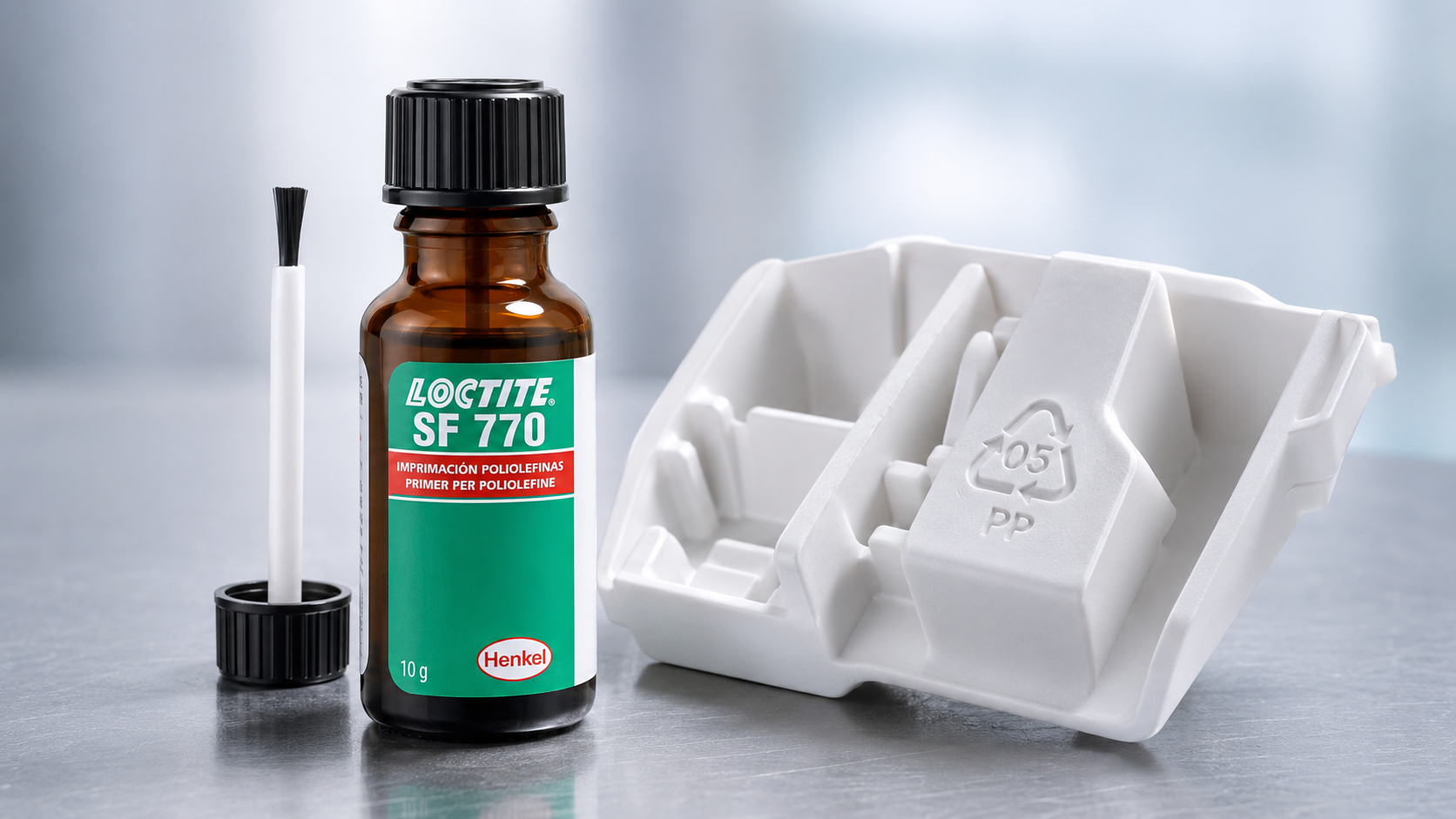
Some plastics are surprisingly difficult to bond. The adhesive may appear to hold at first, but the parts separate under relatively low force. In many cases, the problem is not the adhesive—it is the surface of the plastic.
Polypropylene (PP), polyethylene (PE), PTFE and some thermoplastic rubbers have what is called a low-energy surface. A simple comparison is water on a freshly waxed car: instead of spreading, it forms droplets. Adhesives behave similarly on these plastics and cannot properly wet the surface to create a strong bond.
Why roughening is often not enough
Polypropylene is lightweight, moisture-resistant and highly resistant to chemicals, detergents and alcohols. These are excellent properties for the finished component, but they also make bonding difficult.
Sanding or roughening may seem like the obvious solution. However, testing on polypropylene showed that surface roughening alone did not create a statistically significant improvement in bond strength. The main challenge is the surface chemistry—not simply its texture.
The solution: LOCTITE SF 770
LOCTITE SF 770 is an adhesion-promoting primer developed for difficult-to-bond, low-energy plastics. It prepares the surface so that LOCTITE cyanoacrylate instant adhesives can properly interact with the material.
In simple terms, the primer creates a chemical bridge between the plastic and the adhesive. A joint that initially appeared almost impossible can become strong enough for the plastic itself to fail before the adhesive bond.
Testing showed that LOCTITE 401 used together with LOCTITE SF 770 achieved the highest bond strength on polypropylene, typically resulting in substrate failure. Henkel’s technical data also reports typical block shear strengths of up to 15 N/mm² for polypropylene bonded with LOCTITE 406 after SF 770 treatment.
Simple application
The process is straightforward:
- Clean and dry the surface.
- Apply a thin layer of LOCTITE SF 770 to the low-energy plastic.
- Allow it to dry—typically around 8–9 seconds at 23°C.
- Apply the selected LOCTITE instant adhesive and assemble the parts.
Only a thin layer is required, and excess primer should be avoided. The primer is also visible under 365 nm UV light, making application control easier in production.
Improved formulation and safety profile
LOCTITE SF 770 has been upgraded by replacing the original n-heptane solvent with isopropyl acetate. This provides a more favourable safety and environmental classification while maintaining the primer’s technical function.
The product is still highly flammable and must be handled with appropriate ventilation and protective equipment. Always check the current Safety Data Sheet before use.
Turning a difficult bond into a reliable solution
Low-energy plastics are not impossible to bond—they simply require the correct surface preparation. With LOCTITE SF 770 and a suitable LOCTITE cyanoacrylate adhesive, strong and reliable bonds can be achieved on polypropylene, polyethylene, PTFE and thermoplastic rubber.
Sometimes the difference between a failed bonding trial and a successful solution is one very thin, almost invisible layer of primer.
Need help bonding a difficult plastic? Contact Bodo Möller Chemie Baltics. Our technical team can help select the right primer and adhesive combination and support practical testing with your actual materials.